In a move to bring back the excitement to Eurovision, in a similar way that exploding nipple-clamps brings back excitement to a doomed marriage, the powers that be have decided that the 2016 dross-a-thon will have a public vote. Oh yes, I can hear the joy on your breath already - because, like I do - this brings to the forefront of the world's largest abuse of the word "talent" show, two of the things I love the most in the world: voting systems and throwing heartfelt and whimsical abuse at the Eurovision Song Contest.
First, the technical side of things. Previously the vote was done by each country getting a jury of "music experts" / coked-up shaved monkeys to vote on the best act, the people of each nation that actually think Eurovision is worth voting on, to hit their phones to record their vote, and then it gets averaged out to give out the countries votes in preferred order/Russia as number one if within invasion range. So far, so inevitably not England winning and, because of the number of countries involved and a max of 12 points to hand out, it meant that half of the voting section of the show was wasted as a quarter of the way through someone had mathematically inevitably won and there are only so many times over twenty minutes you can show the same person trying to emote shock, surprise, and joy over something only an act of a god with a decent taste in music could stop.
The new system "creates TV magic" (their honest to god words, all complaints to info@eurovision.tv) by giving each countries' public an equal number of votes to their jury. After all, the official voting is drummed out with the monotony of a Thursday afternoon school assembly, and they will then, in reverse order, read out how many total votes each country got from the plebiscite. Technically this means that no-one knows who will have won until the very last moment, in reality it means that you get to sit through even more tedium on an already interminably slow show. Oh yeah, and it'll give the public an enhanced sense of empowerment, so it'll drive a lot text messages and give them more dollar. There is also, thanks to the app, the increased chance of someone trying to rig the vote in a more direct fashion, however Eurovision have assured everyone that that isn't possible, mostly by not admitting it is.
Anyway: on a technical level its main advantage is that "politics" (i.e. Russia) can't be too involved with the final decision and the Jury can't disagree as much with the public as before, so there will be less outcry if "the wrong act" wins. However, you still have the same basic issue as before of, if a countries Jury gives an act a 2 and the public give it a 10 it still averages out as a six, it's just now out of a possible 24 rather than 12. You also continue to have the problem of the public voting politically, rather than on an "is it actually a good act" level (Russia is basically never getting another point from the Western public) that the jury may actually be skilled to vote on. You also continue to have the issue of Cultural Closeness, wherein countries with similar musical traditions and cultures will tend to vote for each other because they 'just like the tune' because it sounds like what they hear on the radio all the time, rather than being able to make an objective evaluation of it. Oh yeah, and boobs are really going to come into play here, as there are going to be a lot of votes up for grabs if you can convince the audience that there is a chance of seeing more butter being churned, even though
So will any of that change things for the UK? No, obviously it won't because our selection criteria continues to be "are they a bloody disgrace compared to everything else we have on offer?". It's just that now we get to firmly see how much the voting public of Europe hates it, in unequivocal terms. But mostly it's just a bit of pointless deckchair moving. As an attempt at trying to be a bit more representative of the public tastes it fails, as populations aren't taken into account, as an attempt to inject some excitement it fails, as there is still the tedium of the jury section before most of what's gone before gets made pointless by the lighting round, and as an attempt to remove politics it fails, as the assumption that the audience isn't political has been proven well and truly false over the last couple of years.
About the only thing it really does is prove that the Eurovision are unwilling to deal with the basic overblown nature of the show, and that they think a bit of mid 2ks interactivity will shake things up in any meaningful manner. Because as far as Eurovision are concerned, the show will always go on, and on, and on, and on....
Showing posts with label technology. Show all posts
Thursday, 18 February 2016
Thursday, 7 January 2016
Turntables at CES
To go with the recent news that "Vinyl Is Saving Music!" (it isn't, it's 7% of the market that happens to be a more expensive product so makes up a lot of sales value), Sony and Panasonic have turned up to the Consumer Electronics Show ("This is what you could have had for Christmas!") with a pair of turn-tables. And thus "Vinyl Is Back!" screams everyone who hasn't got a clue what they're talking about but this time hopes they're going to be on the Cool Train.Now firstly, and I want to make this very clear, the two decks in question are "Nice!". As in 'audiophile says these things are good bits of kit' nice. The Technics are essentially a more modern version of the SL-1200G which everyone of "a certain age" and calibre in DJing has used, because they were actually that good. Even if you weren't of the right calibre you've played on a rip-off of them, because they were just that ubiquitous for a reason, and now they have a nicer direct-drive motor in them so you'll get a smoother mix IF you still use vinyl. Which most people stopped doing years ago, which was why they stopped being made.
The Sony offering PS-HX500 is different approach entirely; essentially the most tricked out version of the "convert you're vinyl to MP3" that everyone one in the days between after you started switching to digital and before you found out you could download someone else's better copy from Pirate Bay. It's got internal audio-to-digital conversion, edit/mixing software, and you can technically hook it up to a audio rig and play out on it at a real good quality.
But you won't if you're serious about your music, because it's vinyl and vinyl sucks. Or, at the very least, it does when compared to modern formats. Yes, vinyl had a very important place in the history of music, and, yes, there was something nice about going to a record shop and fingering through the album racks, and, yes, if you must be the kind of person who's most important format decision is how obviously you can show off that you bought a record, it's nice to have a large physical item with a big cover on the front. I know this, because I've got a collection of vinyl myself as I go weak at the knees being able to touch a bit of music history; it mostly sits on the shelf whilst I listen to the FLACs. Some people still DJ on vinyl, however the two biggest reasons to do this are because it's all part of the performance of that particular event or they are stubborn die-hards that also don't set the levels back when they've finished their sets. Anyone who does it because it's only available on vinyl has long since converted the music to digital, because it's the only way to keep such precious content from falling apart.
Vinyl is heavy, awkward to carry, deteriorates rapidly, and is expensive to produce, ship, and stock. The reason that CD and digital is doing so well right now is because it's about a million times better for most everyday usage, be you a DJ or a regular listener. At one time vinyl sounded the best for the period, before wear and tear kicked in, but those days are gone and you can demonstrably get a far better sound from digital now, as scientifically proved on a number of occasions. You can also, if you're into making music, get it out and about in minutes rather than months by using the magic of electronics.
What's happened with the recent vinyl boom is that a bunch of people decided to be hip and focus on the iconography of vinyl and the retroism of it. The novelty of buying something which a whole generation are just not used to seeing anywhere has kicked in, it's become a cheap luxury item and a means to show musical eliteness with the minimum of effort. And because of that boom Sony and Panasonic have gone "lets make the thing that everyone is asking us for, because everyone's got an MP3 player or streaming device and they all threw their record players away in 2005". They are adding either some minor technical innovation (because it's a technology that stopped advancing 20 years ago) or some consideration to how the technology is being used these days (because the other formats are just more convenient). But they are not going to break the bank with these devices, because vinyl is not going to come back as anything more than niche. No matter how much people scream about it.
Which is not to diminish the kit they are selling, because it is very nice.
Sunday, 24 May 2015
2005: the year it all went a bit wobbly
I have a pet theory: the musical landscape was irrevocably
altered in 2005, and since then no new scene has managed to get
"Big". I appreciate that it's a controversial comment to make, and
that it also happens to be around the time science says I stop listening to new music,
so I want to make it clear that I'm not saying good new music stopped being
made then (because you can find awesome new music everywhere). I'm simply
saying that "Big" slowed down as being possibly for new acts and
scenes, at least in the context of what had happened before. And why am I
saying 2005? Because that was the year that YouTube landed, marking it as the
year that the shared cultural youth experience (one of the most vital things
for new things to become Big by) finally got a nail in the head and that
scarcity in youth culture stopped being a thing.
Back in the day when the internet was just
this weird thing that either hadn't been invented by computer visionaries, was
a wild idea of computer science theorists, or was that strange thing the
computer students swore they weren't using to look at porn with, there was a
high cost of entry into any youth culture, driven by scarcity of the resources
relating to that culture. For example, if you wanted to listen to music you had
to go and buy the record, or at the very least the tapes to copy it from
someone who had bought the record, and you had to buy the means to play that
record, But even if you had that record you were limited on where you could
play it and you were limited by possibly not even knowing that the record
existed or how to contact the people who sold the record. Similarly if you
wanted to join a scene you had to spend a large amount of time finding out that
the scene existed, where it was, and then you would have to go along to it with
no real clue what the culture was like and with the likelihood of sticking out
like a sore thumb. If you then wanted to join that culture you would have to
invest a considerable amount of funds and effort on buying the uniform of that
scene, mostly due to the small number of places actually selling the clothing
in question. To put it bluntly: it was a total arse, and because it was a total
arse a lot of people didn't move that far outside of their youth scene, even
before the tribal violence and rejection fears of the times.
Additionally there were very few media
outlets at all for youth music of any kind, let alone whatever scene you may
have happened to have been into. On the telly there was Top Of The Pops, and at
any given time one or possibly two other music programs (including "Youth
TV", which doesn't really count as that has always been terrible) which
generally compressed the whole world of music into one show so your rockers and
your indie kids and your ravers would all be watching the same show, and
'booo'ing and 'yayyy'ing along like football fans because they all had a lot of
stuff that you didn't really like but were willing to watch through for the one
or two acts that you did. But even then you would be more likely watching
because it was an act from the scene you liked rather than a bad you actually
raved on about, with you watching to represent and go "more of this kind
of thing please!". This is why The Stone Roses and The Happy Mondays on
the same Top Of The Pops was heralded as the triumph of Madchester when they
sound like two difference scenes, why Blur vs Oasis was the battle of Britpop
rather than retro-pop vs indie-rock, why Rage Against The Machine got big with
the rave party kids via The Word and why everyone with a leather jacket I knew
watched Slipknot literally destroy the cameras on TGI Friday (even though half of
them couldn't stand them). Yes, from the mid 90's if you had access to the
mysterious "cable TV) you could watch MTV but that basically meant
"20 hours of Radio One a day, with one or two specialist genre shows a
night", so if you're scene wasn't flavor of the month then you still had
the bottleneck happening where everyone on your scene was watching the same
thing.
Now, whilst this may all sound like a pain
(it was) those bottlenecks were also very useful because it gave
"Bigness" and avoided the cultural balkanisation and scene hopping
that is now happening (two contradictory but linked concepts). Because you had
a lot of people knowing the same songs (regardless of if it was their thing)
the songs could get "big" and get a decent floor going in the club,
because you were listening to a lot of music you would never think of listening
to a band could find an listeners from a wider audience, because niches were
part of a larger overall scene you had more people turning up to broad interest
events (well, at least outside of London) so there was more crossover, and
because you had to go an engage in a scene to discover things you actually had
to get out there and partake of it. From my personal prospective this gave us
things like the genre spanning Llollapalooza and leather jackets turning up at
raves because The Prodigy had thrown in some guitars and the goths had dug a
few Ministry Albums,(then again it also gave us the ubiquitous "Crap
Thrash Hour" at the start of every rock club so it may not of all been
good). New sounds, new scenes, new tastes could gain traction due to all the
reasons listed above.
Then 2005 happened, and Youtube removed
the first bottle neck of scarcity. Very rapidly any music you wanted to hear
would be accessible to you in minutes, your very own Top Of The Pops playing
just what you want whenever you want it. So people ended up listening to just
what they wanted, because if you just wanted to listen to hardbag or pornogrind you could do, all day if wanted. You could
go as niche as you want and never have to touch anything else. Then MP3 players
and broadband became mainstream and took down the second bottleneck, meaning
that you could download a bands discography in less time than it would
previously of taken to find their single in a shop and you could carry it with
you everywhere you wanted with no compromise of availability. Then eBay removed
the bottleneck of stylistic scarcity, by making all the clothing available. You
didn't have to live near or travel to that one specific store that sold the
clothing you wanted, you could sit at home and have 5 stores come to you (and
at competitive prices!). All of this was aided by Google having taken down the
final bottleneck of knowledge scarcity, so if you wanted to know anything about
a scene, from what was happening where to where you could hire a venue to how
to spread the word to what was trendy and wearable, you could get it in a
couple of minutes.
This was, and will continue to be, mostly
awesome. New things to listen to, new places to go, new sounds to hear.
But not all of it is that great, as with
the removal of scarcity meant there was no underground for this to dwell in for
all that long before they go prematurely big. Or, at the very least, latched
onto an chewed through by the novelty hungry machine that was the media. As
more and more obscure things came into sight they were all now given their
moment in the sun, but often before they could organically grow enough of a
following to survive that moment or capitalize on it. Scenes didn't have enough
time to become actually big before being pronounced the Next Big Thing and then
tossed aside as the long queue of Next Big Things was worked through as rapidly
as possible. Things also haven't been helped by the increased discover-ability
to the listening public has come along an increased dispensability, as it too
goes through a thirsty journey towards novelty and freshness. It is perfectly
possible to hear about a new scene on the Monday, have listened to the music on
the Tuesday, to have sourced all the fashions on the Wednesday, and know about
all the events on the Thursday. Weather someone will then actually go to the
event on the Friday is up for debate, as they could easily have moved onto the
next thing before then. Scene-hopping and a cultural flatness brought on by
observing rather than engaging is developing, you don't even have to go to the
shows any longer as you can see it through someone else’s phone video so how
can a new scene maintain the excitement needed to become "big" when
all of it's mystique is gone at the very first whiff of discovery?
Instead of bigness we have, in most cases,
an outbreak of smallness. Niches and specific scenes are totally possible
because you can find enough people to keep them going, which is a great thing
in many ways but it also leads to the balkanisation that was described above
and a staleness that people don't seem to quite get. For example I recently had
a friend make the very reasonable and true comment that nothing new had
happened in Classic Metal for years now, but I had to point out that that was
because all the things that could happen with it had happened about 20 years
ago with Nu Metal. With any kind of music its the simple case that if you're
going to have a genre described by standing still and a scene made up of people
who want a very specific thing it can't evolve or significantly grow because
it's whole reason to exist is it's constraints, it's like looking at Baroque
and going "well I like it but can we throw in some synths and
blastbeats?" The availability of the niche scene has created its own
bottleneck where things can't evolve without having to exit the scene, and
because there isn't as much group experience available it's not by gathering
more people around it but by going and creating it's whole own new scene.
The fact that hardly any new acts that
could authentically be described as "underground" are making it into
the charts (even the previously awesome 40 to 20 region) is testament to this
by itself, with the aging of the headline acts at underground events giving
further fuel to it. And it's only going to get worse, as the money is falling
out of music so bands and events have less ability to hang around that long and
more intensive to find and focus on a specific market. The removal of the
bottlenecks has leveled the playing fields, it's just that it appears to have
done it by driving things down rather than bringing everyone up. This is why,
more than ever, it's important to get out there and represent not just your
particular scene but the broad umbrella scene that it came from, to help and
keep everyone afloat. Plus, you never know: you might hear something you like
but never thought of listening to before.
Tuesday, 31 March 2015
Legally mandated post about Tidal
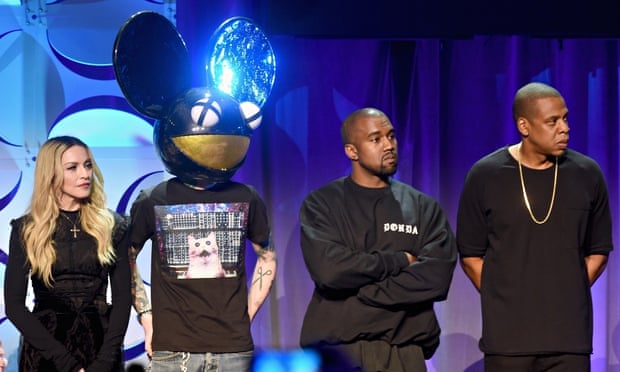
| Tense moments at the Top Gear auditions. |
And it's all very lovely, all very impressive, Madonna got to be a briefly erotic granny, there was a lot of talk about paying artists more money than the other services (mostly by charging twice as much for in subscription as everyone else), and given that Mr Carter is somewhat of the entrepreneur it's going to make money. But will it conquer the world? Nope, I really don't think it will, because it's missing out on a couple of key things.
Firstly it's claim of being better for the musicians, by boasting about how much it will pay the artists. This is actually somewhat misleading, as it will pay The Rights Holders more than other services. If you are an artist who owns their recordings then you are going to be doing good, however a lot of people aren't on that great a contract when it comes to streaming so until they get those changed they will mostly be making not that much times two. Don't get me wrong, double is good. But when it's double of almost bugger all once the record label has taken the cash it's not really that awesome, assuming that Tidal can get enough subscribers which it intends to do though sound quality and guilt trips.
The sound quality thing is a curious "and" for me, as it's a kind of pointless exercise on a couple of fronts. If you are streaming at home then the other services product is available at sufficiently high quality as it is that you won't really notice the difference (especially when with high quality content you rapidly reach a point where the speakers rather than the source define a lot of what you hear). If you are streaming on the go then high-quality means lots of data means a service that's going to eat your monthly plan and/or your battery, assuming that you can connect to a solid enough signal to get the stream onto your phone. So you basically have something that you can already get at home via other services or that you are going to have to not use to it's full extent if you are on the go. This is before you reach the question of "can the listener really hear the difference?" which isn't being snobby but repeated experience of no-one I've meet really being able to tell if something is over 300kbps MP3 quality unless they really, really, concentrate very hard. I'm sure someone with a couple thousand pounds of audio equipment in their lounge would be able to tell the difference, but at that point you have to ask 'why haven't they got the CD, as that will always sound better'? And yes, you can download and listen offline, which is now basically the standard anyway and is done at perfectly acceptable quality levels by everyone else). BTW if you think you can tell the difference then take the test.
As the for the guilt trip? Given how much they go on about the artist and the way they "didn't like the direction the music was going" then it's clear that they are trying to attract the "real" music fan, by which they mean 'people who are willing to pay more for their music' and 'anyone who doesn't use those other, cheaper, nasty exploitative services'. Right... because history has proven that the average internet user is always willing to listen to moral arguments when faced with the choice of free-by-piracy or expensive-through-unnecessary-purchase. I can totally get that they are going to try for encouraging the fans, and week long exclusivity contracts, but other services had to keep their costs low for the single reason of the public's unwillingness to pay and I don't think having some of the richest starts in popular music standing in a line to go 'please, we need more cash!' is really going to help things. Maybe if they head a couple of unknowns or not so massive names on there as well it would have been different, but right now it's hardly presenting a radical redistribution of wealth that it's proportioning to be.
So, will it work? Yes, it'll work. There is enough artistic weight behind it and Jay-Z is a great businessman who is brilliant at PR. But I can't see it becoming gigantic, and I certainly can't see it becoming the next Spotify. It will become, gradually, a premium option, something for people who want to show their support or opulence off with. It'll find an audience of it's own and that will grow, but the chances of mass appeal are limited, especially with its key product differential being so mostly pointless and limited by the improvements of various supporting technologies. Still, it gave everyone on stage some nice hype, so it worked out in the end.
Subscribe to:
Posts (Atom)