Showing posts with label books. Show all posts

Sunday, 22 November 2015

This Music Leaves Stains: The Complete Story Of The Misfits by James Green JR.

I've been thinking about doing an article about the influence that horror, sci-fi, and similar B-Movie
schlock has had on punk rock - and to a greater extent, rock music as a whole. However James Greene Jr.manages to do such a good job of it in pages 3 to 7 (covering the tradition of dark fantasy theme within rock since it's inception, the unrelenting thirst for content of 60s & 70s USA TV stations pumping the movies out, the move from 40's & 50's ideal lifestyles to economic pressures forcing mothers into the workplace causing more TV viewing by kids, and the kitschy anti-establishment & juvenile escapist joys found within them)... that there really isn't much more to add to his thesis.

As an added bonus, his observations are followed by a full and fully researched history of the progenitors of the Horror Punk genre. Starting with the first musical endeavors of founder member Glen Danzig and working it's way through to the contemporary Jerry Only period of the band, this book uses a combination of the historical record and interviews with an extensive range of members and associates of the troupe. Whilst doing so, it also gives a wider idea of the Misfits place and importance in the history of punk rock as a whole; something that previous works like American Hardcore: A Tribal History have touched on but never truly given the credit owed, due to either the lyrical/performance content of the heavy metal elements of their work not fitting into the established narratives of the genre.

Given the number of people who have gone through it's ranks, and the amount of disagreement over what did or didn't happen (often settled by legal action), the "give everyone's view, and let the reader decide" approach adopted by Greene is a practical solution to a complicated problem. It's also an approach that could leave the reader unsure as to what may have happened, however there is sufficient editorializing opinion thrown in to make it clear where the writer sits on many occasions. This could upset Misfits fans with a strong viewpoint on the personalities involved (which boils down to Danzig Vs Only), but the appreciation shown for the music and performances should avoid alienating all but the most entrenched of fans.

What you mostly get is a clear yet wistful message that if the band hadn't had it's internal rifts, it would never have produced the content it did - but the band could also have been so much more successful than it was. You also get some interesting (and often sarcastically funny) insights into what is involved in writing a book such as this, plus the egos that can continue, decades after the events. Add to this the true story of a band that failed to succeed at the time but became a huge influence to those who followed and the eventual return (of sorts) to the deserved acclaim all of this, helps make this book a great read, be it for fan or soon-to-be fan of the band.

Monday, 14 October 2013

The Lost Gospels According to Al Jourgensen

Al Jourgensen has done an incredibly large amount of drugs, however he has never let that get in the way of him making some incredibly good music. What it has got in the way of is him making an autobiography that is going to have much variance beyond the "did A, did a lot of drugs, did B, did a lot more drugs..." cycle or raise many questions beyond 'How much more debauched can this lifestyle possibly get?' and 'How the hell is he not dead already?'. It's also got in the way of believing a lot of what is said, as Jourgensen admits to being utterly void of memory about many chunks of his existence whilst being adamant about juicy details of him slagging people off, which Jon Wiederhorn manages to deal with by getting the other side of the story from a lot of people who were also there and in the firing line.

This is not to say that reading it makes you dislike Al Jourgensen his childhood story gives some sympathetic background as to how he ended up as he did and he is refreshingly honest about the bad things he has done, without being apologetic or pious. It's also not to say that his story is dull, as he gives some interesting insight into several major counter-culture individuals, including Timothy Leary during the later part of his life. It's just that if you were looking for something about the music or the performances of Ministry you are bang out of luck as he can't remember about 80% of his recording career and he hates live performances so doesn't really want to talk about them. What you have got is a junkie tale with a lot of punches, some amusing tales of self-destruction, and an insight into how the recording industry can be a horrible and abusive place. You also have an a scan into the mind of one of the few geniuses of industrial musical and a true survivor of rock, as well as a rock autobiography without any of the faux-sleaze pseudo-chic or self-important complaint that the genre normally spews out (Looking at you, Motley Crue).

In the end I'm really not sure if I can encourage you to read this book or not: I know that around halfway through I mostly carried on reading due to the 'what will he do next?' freak show factor rather than any actual interest in what was going on, but at the same time there were always sections that left me laughing and eventually happy that I had stuck it out to the end. It's well written, well researched (other than the contentious bits) and not a bad read once you get past the subject matter. Ministry fans will read it regardless of what is said, though I doubt it will give any greater or lesser appreciation of the music to them, so I guess it boils down to 'how much do you care about the music of Ministry' and 'do you want to read the story of a very amiable junkie'.

Sunday, 25 September 2011

The Secret History of Rock'n'Roll - Christopher Knowles

Christopher Knowles has a theory: that the various forms & traditions of rock music can draw their heritage, aesthetics, and concepts back to the mystery cults of antiquity. After 4,000 years of human existence mankind is rocking out in the same way that the Bacchanalian, Korybante, Isis,Puritan, and Orpheus cults (to name but a few) have been and that distinctions like thrash, punk, glam, or AOR are less useful than the intent & style of the performance. This is a highly intriguing theory that mixes history with anthropology and rocking out. Potentially pure gold, however the execution ranges from never getting beyond intriguing to frustratingly underdeveloped. The first section sets the scene for a fall with a 94 page, amazingly readable, romp through the various mystery cults (secret religious organisations with exclusive memberships & spooky rites) of history. The Jungian archetypes come thick and fast, laying down a template of "nothing new under the sun" and setting the stage for an exploration of modern music. Sadly the second section fails to cash in on the promise as rather than going into any detailed exploration of the premise you get a brief overview of a cult, a quick link to some of the bands from 1960 to 2005 that tie into it and then a potted history of their career. It's far too brief, highly scatter-shot, and under-develops the concept beyond "I have a neat idea". It's not clear as to the reason of this shortfall, as Mr Knowles clear knows his stuff. Maybe it was an over-zealous editor wanting to keep it under a word-count or maybe the net was cast too widely to be able to cover all the potential topics in time. Whatever the reason it just falls short and leaves the reader wanting more. This is not to say that it isn't worth giving it a read as it is honestly enjoyable, just that you'll have to fill in half the content for yourselves.

Wednesday, 2 March 2011

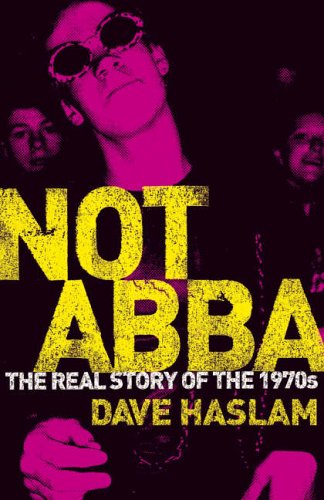
Not Abba: The Real Story of the 1970's

The basic premise of this fine read from Dave Haslam is that the 70's were not as simple as 'Abba ruled and then Punk happened' and the music of those 10 year's needs to be viewed as a reflection of the deep changes happening politically, socially, & economically in Britain with each year reflecting a distinct phase of this progress.

Sound's heavy but actually ends up being a good story that provides an insight to that period, using a combination of credible mainstream sources and individuals who lived through the period, and presents it as being a lot more dynamic, real, and interesting than I had known before. It also throws up some interesting theories on the music scene's development, such as Northern Soul having been responsible for the independent music store scene that let Punk blossom, the twee Pop Music of the early 70's being an attempt to get back to the pre-war simplicity of the 1930's, and that Two-Tone was a reflection of British working class life rather than an attempt at creating 'unity'.

All great stuff, until the final section of the final chapter when Margaret Thatcher gets elected and your left with nothing but Tory bashing all the way into 1984, which is apparently when both music and the 70's ended.